Beginner F2L Tutorial: Solve the First Two Layers Intuitively
Learn intuitive F2L step by step. Pair Rubik's Cube corners and edges, handle special cases, and solve the first two layers faster.
By CubeRush · Published · Reviewed
F2L—short for First Two Layers—is the part of CFOP that replaces solving first-layer corners and middle-layer edges separately. Instead, you pair one corner with its matching edge and insert both pieces together. Repeat that four times and the first two layers are finished.
This beginner F2L tutorial is intentionally intuitive. You only need four short inserts, then a repeatable way to turn unfamiliar positions into one of them.
Before you start
You should already be able to solve a 3x3 Rubik's Cube with a beginner method and make the cross without help. Keep the completed cross on the bottom throughout F2L. That makes it easier to see pieces in the top layer and protects the work you have already done.
Rturns the right face clockwise;R'turns it counter-clockwise.Lturns the left face clockwise;L'turns it counter-clockwise.Uturns the top face clockwise;U'turns it counter-clockwise.- A move is clockwise when you look directly at that face.
The four beginner F2L inserts
Most beginner cases finish with one of these moves. Learn the motion with your fingers instead of reciting letters.
| Case | Pair position | Insert |
|---|---|---|
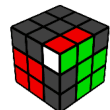 | Pair above the front-right slot, white sticker facing right | R U' R' |
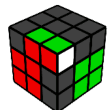 | Mirror on the front-left, white sticker facing left | L' U L |
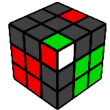 | Split pair above the front-right slot | R U R' |
 | Mirrored split pair above the front-left slot | L' U' L |
Step 1: Find a corner and its matching edge
Choose a white corner. Its other two colors identify both the edge you need and the slot where the pair belongs. A white-red-blue corner belongs with the red-blue edge in the slot between the red and blue centers.
Bring both pieces into the top layer. If one is trapped in a slot, turn that slot up, move the piece aside with U, and restore the cross. Use an unsolved slot whenever possible so you do not break a pair you have already inserted.
Step 2: Check the white sticker
There are two useful families of cases.
White is not facing up
Place the corner above its destination slot. Turn the top layer once so the white sticker is still visible from the side. Now compare the colors facing up on the corner and edge:
- The top colors match: hide the corner temporarily, place the edge beside it, restore the corner, then insert the connected pair.
- The top colors differ: arrange the pieces so they stay separated in the setup, then use the matching split-pair insert.
The idea matters more than the exact turns: hide the corner, position the edge, bring the corner back, and insert.
White is facing up
Match the non-white sticker on the edge to its center. Turn that face away so the edge moves toward the back, place the corner above the edge, and restore the face. The corner and edge are now paired and ready for one of the four inserts.
Step 3: Handle connected or awkward pieces
Sometimes the corner and edge are connected incorrectly, or a piece is buried in a slot. Do not memorize a separate algorithm yet. Split the pieces first:
- Move the corner into an unsolved slot.
- Turn
Uto move the edge away. - Bring the corner back to the top.
- Solve the new normal case.
This approach may use a few extra moves, but it builds an understanding of how pieces move. That understanding makes later F2L improvements much easier.
How to practice beginner F2L
Start slowly and solve without pauses. Turning faster while searching for pieces only creates more pauses.
- Solve the cross, then stop the timer and complete four F2L pairs deliberately.
- Name the corner's two side colors before looking for its edge.
- Track the next pair while inserting the current one; this is the beginning of lookahead.
- When one case repeatedly feels awkward, note the position and find a shorter solution after the session.
Your first goal is not a move count or a sub-30 solve. Aim to recognize a pair, build it, and insert it without returning to the beginner layer-by-layer method.
Common beginner F2L mistakes
Solving with the cross on top. Keep it on the bottom so the top layer remains your workspace.
Rotating the whole cube for every pair. One rotation to place a slot at the front is fine. Repeated rotations hide pieces and interrupt lookahead.
Breaking solved slots. Before lifting a corner from the bottom, move an unsolved slot into the face you plan to turn.
Memorizing all 41 cases immediately. Intuitive F2L first gives the algorithms meaning. Optimize difficult cases once the basic pairing process is automatic.
What comes after F2L?
When all four pairs are inserted, the bottom two layers should be solved while the top face remains mixed. Continue with 2-look OLL to orient the last layer, then finish with 2-look PLL.
Further learning
This guide was informed by J Perm's full intuitive F2L tutorial. Watch the demonstration when a written setup is hard to visualize, then return to untimed practice and reproduce the idea on your own cube.