2-Look OLL Tutorial: Easy Rubik's Cube Algorithms for Beginners
Learn 2-look OLL with easy recognition tips and beginner algorithms to orient the last layer of a 3x3 Rubik's Cube.
By CubeRush · Published · Reviewed
2-look OLL orients the last layer of a 3x3 Rubik's Cube in two stages: first make a cross on the top face, then turn all four top-layer corners upward. It is the beginner-friendly version of OLL in the CFOP method.
Full OLL has 57 cases. Two-look OLL covers every possible position with 10 algorithms, so it is a practical next step after learning intuitive F2L.
What OLL solves
OLL means Orientation of the Last Layer. At the start, the first two layers are solved. At the end, the entire top face is one color. The side stickers do not need to match their centers yet—that is PLL's job.
Hold the solved F2L layers on the bottom. In the examples below, the last-layer color is on top.
Look 1: Make the top cross
Ignore the corners and count the top-color edge stickers. You will see a dot, an L shape, or a line.
| Case | Pattern | How to hold it | Algorithm |
|---|---|---|---|
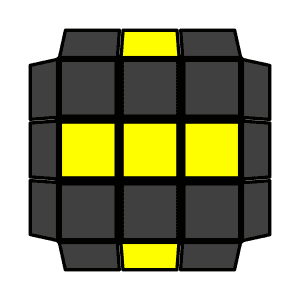 | Line | Horizontal, from left to right | F R U R' U' F' |
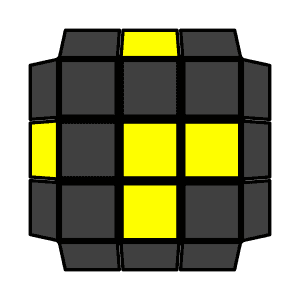 | L shape | The two oriented edges at the front and right | f R U R' U' f' |
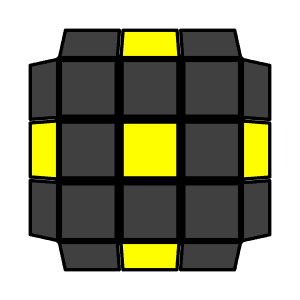 | Dot | Any angle; perform the line case, then the resulting L case | F R U R' U' F' f R U R' U' f' |
Lowercase f is a wide front turn: move the front two layers together. After this stage, the top face has a cross.
Look 2: Orient the top corners
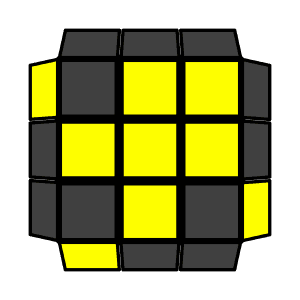
With the cross complete, count how many corner stickers already face up: zero, one, or two. Recognition depends on the stickers on the sides as well as the top.
| Case | Pattern | Recognition and angle | Algorithm |
|---|---|---|---|
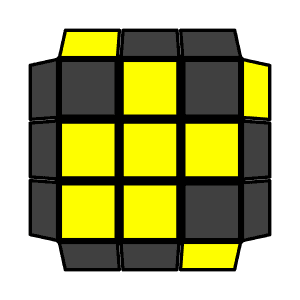 | Sune | One corner up; place it at front-left so a top-color sticker faces you on the right | R U R' U R U2 R' |
 | Antisune | Mirrored one-corner case | R U2 R' U' R U' R' |
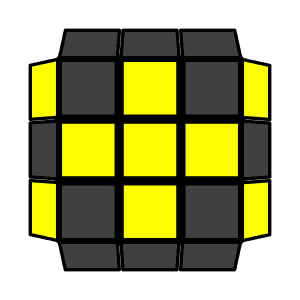 | H | No corners up; two pairs of side stickers point in opposite directions | R U R' U R U' R' U R U2 R' |
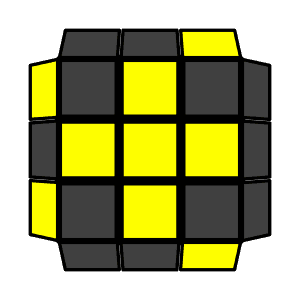 | Pi | No corners up; a pair of top-color stickers points away on the right | R U2 R2 U' R2 U' R2 U2 R |
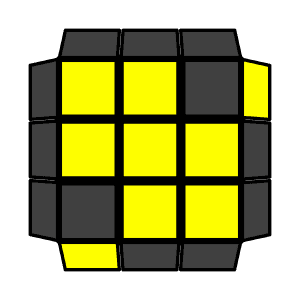 | L | Two diagonal corners up; the other top-color stickers face toward you | F R' F' r U R U' r' |
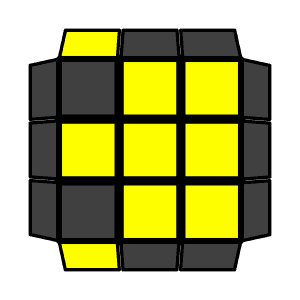 | T | Two adjacent corners up; the side stickers point in opposite directions | r U R' U' r' F R F' |
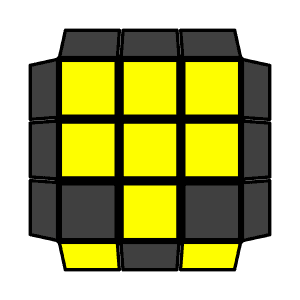 | U | Two adjacent corners up; the side stickers point in the same direction | R2 D R' U2 R D' R' U2 R' |
Lowercase r turns the right two layers together. D turns the bottom face. Confirm the angle before starting; the correct algorithm from the wrong angle will not orient the face.
Learn the algorithms in a useful order
Start with the line and L-shape edge cases. The dot is those two ideas chained together. For corners, learn Sune and Antisune first because their finger movements transfer to many later algorithms.
- Line and L-shape edges
- Sune and Antisune
- H and Pi
- L, T, and U
Learn one or two cases at a time. Perform the algorithm six to ten times slowly, then mix the top layer and try to recognize it without looking at notes.
2-look OLL recognition tips
- Count oriented edges first. Corner stickers do not affect the first look.
- After making the cross, count oriented corners before turning the cube.
- Use side stickers to distinguish similar shapes; the pattern on top alone is sometimes insufficient.
- Adjust the top layer with
U,U', orU2before the algorithm. - Say the case name, not the move sequence. Recognition should trigger the finger pattern.
Common OLL problems
The cross algorithm breaks F2L. Recheck prime marks and make sure F' or f' closes the sequence.
A familiar shape does not solve. The holding angle is probably wrong. Match both the top pattern and the side stickers.
Algorithms disappear under pressure. Practice cases from random setups, not only by repeating the same sequence. Spaced recall builds stronger memory than one long drill.
After the top face is oriented
The top color is complete, but the side pieces may still be shuffled. Continue to the 2-look PLL tutorial to solve the corners and edges in two final steps.
Further learning
Compare the cases with J Perm's 2-look OLL algorithm reference and beginner OLL video tutorial. Different cubers sometimes prefer alternate algorithms; consistency and accurate recognition matter more than choosing a theoretically perfect sequence.