2-Look PLL Tutorial: Easy Rubik's Cube Algorithms for Beginners
Learn 2-look PLL step by step with six beginner case families, recognition tips, and algorithms to finish the Rubik's Cube.
By CubeRush · Published · Reviewed
2-look PLL solves the final layer of a 3x3 Rubik's Cube in two stages: put the corners in their correct positions, then move the edges. It is the last step of beginner CFOP and requires only six case families plus a final top-layer adjustment.
Start here after completing 2-look OLL. The entire top face should be one color, even though the side stickers do not all match.
What PLL solves
PLL means Permutation of the Last Layer. Orientation controls which way a sticker faces; permutation controls where the piece belongs. OLL finished orientation. PLL moves those correctly oriented pieces into their solved positions.
Keep the solved layers on the bottom and inspect the side stickers around the top layer.
Look 1: Permute the corners
Look for headlights: two matching corner stickers on the same side.
| Case | Pattern | How to recognize and hold it | Algorithm |
|---|---|---|---|
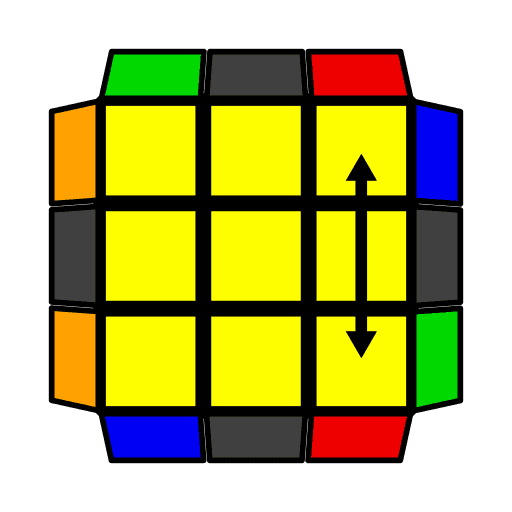 | Adjacent corner swap | One set of headlights; hold it on the left | R U R' U' R' F R2 U' R' U' R U R' F' |
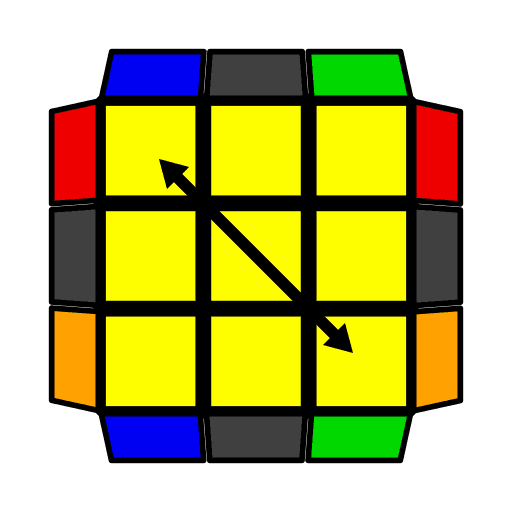 | Diagonal corner swap | No headlights on any side | F R U' R' U' R U R' F' R U R' U' R' F R F' |
After the algorithm, turn U until all four corner side stickers line up with their centers. The edges may still be wrong; that is expected. If every side already has matching corner stickers, skip to the edge step.
Look 2: Permute the edges
Check whether one full side is solved. If so, place that solved bar at the back. The remaining three edges must cycle clockwise or counter-clockwise.
| Case | Pattern | How to recognize and hold it | Algorithm |
|---|---|---|---|
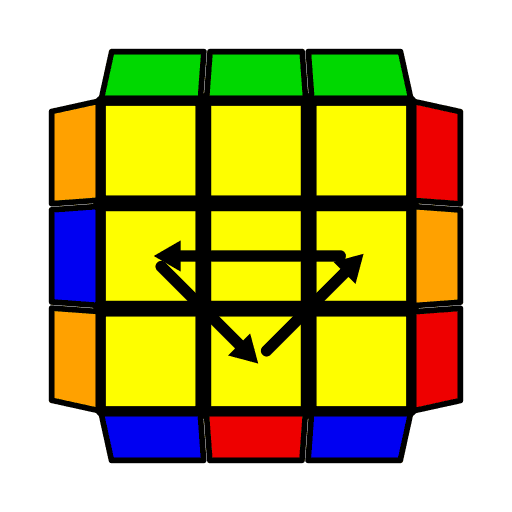 | Ua | Solved bar at the back; front edge needs to move to the right | R U' R U R U R U' R' U' R2 |
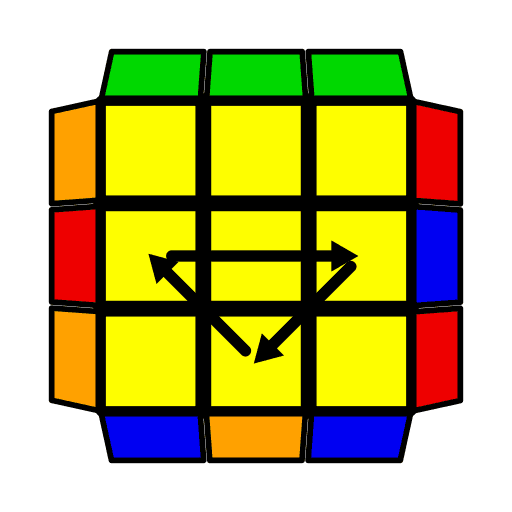 | Ub | Solved bar at the back; front edge needs to move to the left | R2 U R U R' U' R' U' R' U R' |
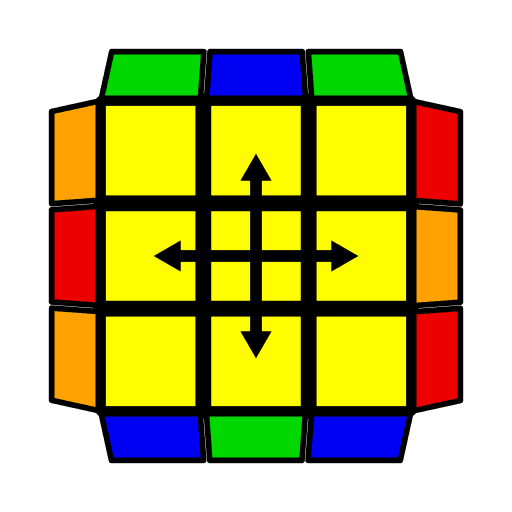 | H | No solved bar; opposite edge pairs swap | M2 U' M2 U2 M2 U' M2 |
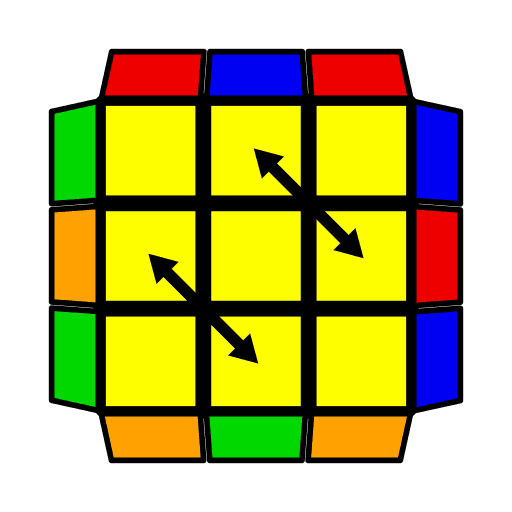 | Z | No solved bar; adjacent edge pairs swap | M' U' M2 U' M2 U' M' U2 M2 |
M turns the middle slice in the same direction as L; M' moves it in the same direction as R. Many cubers execute M2 with consecutive ring- and middle-finger flicks.
Finish with U, U', or U2 if the whole top layer needs to align. The cube should now be solved.
A simple PLL recognition routine
Use the same scan every solve:
- Check the four corner pairs for headlights.
- Solve the corners and align them with the centers.
- Look for a solved edge bar.
- If a bar exists, place it at the back and identify Ua or Ub.
- If no bar exists, distinguish H from Z by checking whether opposite or adjacent edge pairs must swap.
This fixed routine is faster than turning the cube randomly and waiting for a case to look familiar.
How to memorize 2-look PLL
Learn the adjacent corner swap first because it is shorter and more common. Add the diagonal swap when the first algorithm feels automatic. For edges, learn Ua and Ub as a recognition pair, then H and Z.
- Drill the moves slowly enough that every turn is accurate.
- Reset a case by performing the same algorithm again or using a saved scramble.
- Practice recognition separately: pause, name the case and holding angle, then execute.
- Time sets of twelve full solves instead of chasing a single lucky solve.
Common PLL mistakes
Confusing headlights with a solved side. Headlights only describe the two corner stickers. The edge between them may still be wrong.
Holding Ua or Ub with the bar in front. Put the solved bar at the back before executing the listed algorithms.
Mixing up M and M'. Anchor the direction to the outer face it follows: M follows L; M' follows R.
Skipping the final AUF. AUF means adjustment of the upper face. A last U, U', or U2 is part of the solve, not a failed PLL.
When to learn full PLL
Two-look PLL is enough to finish every solve and build reliable recognition. Move to full PLL's 21 cases when these algorithms no longer cause pauses. Many improving cubers learn full PLL before full OLL because the set is smaller and each new case removes an extra look.
Keep improving the earlier steps too. Smooth beginner F2L and a planned cross often save more time than adding algorithms while recognition is still hesitant.
Further learning
Use J Perm's 2-look PLL algorithm reference and beginner PLL video tutorial to check finger placement and case angles. The video is especially useful for middle-slice technique.